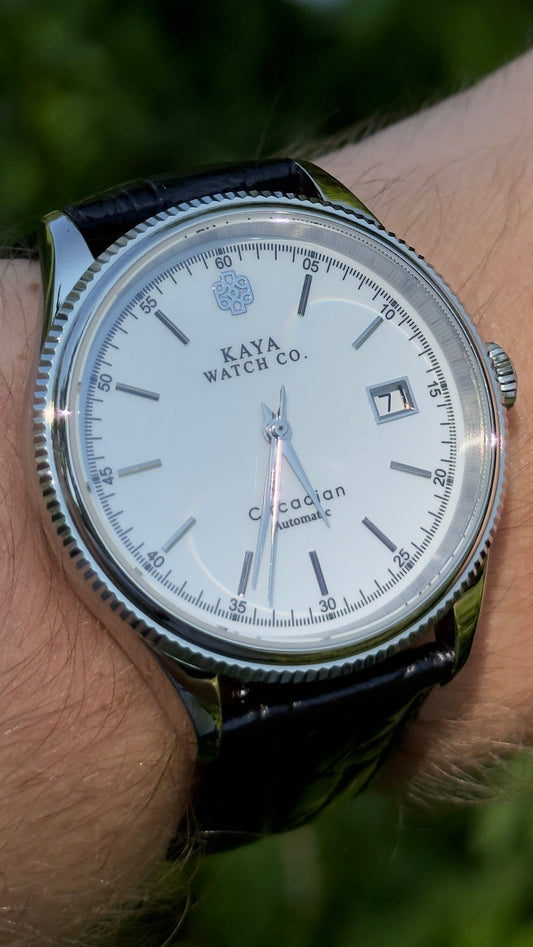
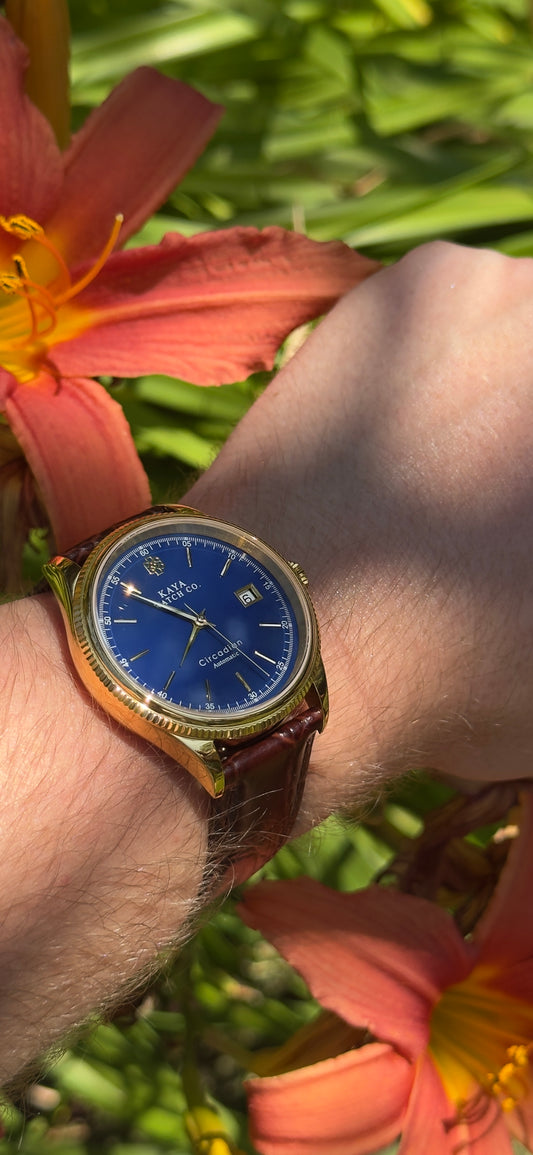
The dial is often the first thing you notice about a watch, so for the Circadian, I wanted it to be something more than simply a background for the hands and markers.
The answer was enamel.
Enamel has been part of fine horology for centuries, long before the modern wristwatch existed. It became particularly prized by European watchmakers for its ability to create exceptionally clean, enduring dial surfaces, and it remains one of the most traditional and respected forms of dial making today.
What makes it so special is that enamel is not paint. It is glass.
From glass to dial
The process begins with a precision-made metal dial blank, carefully prepared and cleaned before the enamel is applied. The enamel itself starts as finely ground glass, with carefully controlled mineral compounds used to create the required colour.
For the Circadian, this process produces three distinct dial expressions: Eclipse, Azure and Meridian.
The powdered enamel is applied to the dial in fine layers before being placed into a high-temperature kiln. At temperatures approaching 800°C, the glass particles soften and fuse together, creating the smooth, vitreous surface that gives an enamel dial its unmistakable character.
The process is repeated as required, gradually building the depth and consistency of the dial.
It is a delicate balance. Glass and metal expand and contract differently under extreme heat, so temperature, timing and cooling all have to be carefully controlled. Too much heat, too little heat or even a small contaminant can compromise the finished dial.
This is what makes enamel so demanding and why it has remained a specialist craft within traditional watchmaking.
Where the character comes from
Once fired, the enamel creates a depth that is difficult to achieve with conventional lacquer or paint. Light interacts with the glass surface differently, giving the dial a subtle richness that becomes particularly noticeable as the watch moves on the wrist.
The deep Eclipse black has an almost uninterrupted quality. Azure reveals a richer blue as the light changes across its surface, while Meridian takes inspiration from the classic white enamel dials that have defined fine watchmaking for generations.
The colours are not simply applied to the dial.
They are created within the enamel itself.
Once the surface has reached the required standard, it is carefully refined and polished before the final details are applied. The minute track and applied markers are positioned with precision, bringing the dial together as a finished piece.
A link to traditional horology
There is something fitting about using such an old technique for the Circadian.
Modern watchmaking has given us remarkable materials and manufacturing capabilities, but enamel remains wonderfully dependent on the interaction between the material and the person making it. It cannot simply be rushed through a production line.
There is always an element of patience involved.
Every firing has to be right. Every surface has to be inspected. Every finished dial has to meet the standard before it earns its place inside the watch.
The Circadian was never intended to be complicated for the sake of being complicated. It is about taking a timeless design and paying attention to the details that matter.
A material with centuries of history. A process shaped by heat, glass and precision. A finished surface designed to remain beautiful long after the day it leaves the workshop.