Ancient stone, precision craftsmanship
There is something particularly special about a natural stone dial.
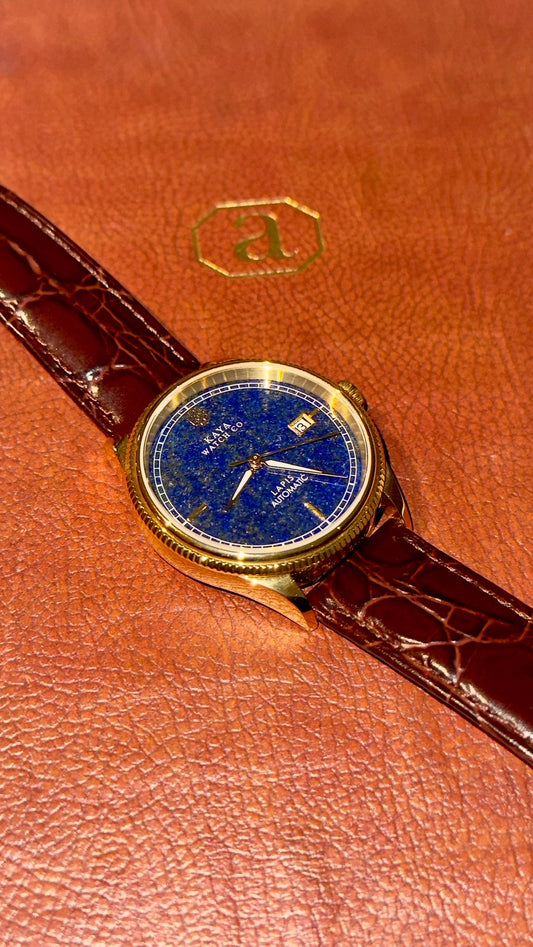
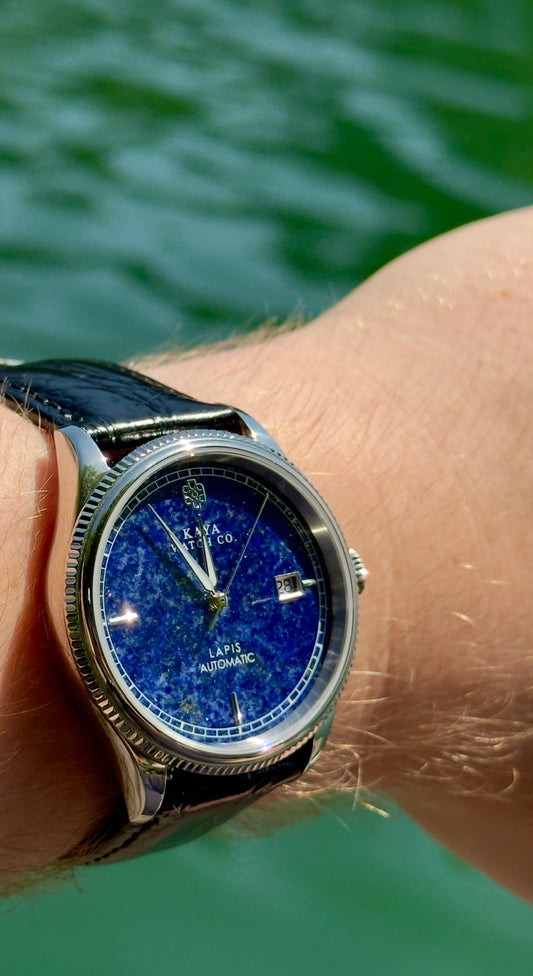
Unlike a conventional dial, where colour, texture and pattern are deliberately manufactured, a Lapis dial begins with something that already exists in nature. The blue, the subtle variations in tone and the occasional flashes of pyrite are all part of the stone itself.
The challenge is then to take something formed naturally over geological time and transform it into a component precise enough to sit inside a mechanical watch.
That is where the craft begins.
A material with a long history
Lapis lazuli has been valued for thousands of years. It has been carved into jewellery, ornaments and decorative objects and, when ground into powder, was historically transformed into the extraordinary blue pigment known as ultramarine.
Its use in watchmaking came much later.
Stone dials became particularly significant in fine watchmaking during the 1960s and 1970s, when advances in ultra-thin movements allowed watchmakers to experiment with materials that would previously have been extremely difficult to accommodate within a watch. Piaget was particularly influential in this period, introducing ornamental stone dials using materials including lapis lazuli, malachite, tiger's eye and other stones. Its ultra-thin 9P movement, introduced in 1957, created considerably more freedom for dial design and helped establish ornamental stone as a distinctive part of the era's watchmaking.
The idea was quite radical at the time.
Instead of manufacturing a surface to imitate nature, watchmakers began placing the natural material itself at the centre of the watch.
That philosophy has continued to influence fine watchmaking ever since.
Selecting the stone
The process begins long before the dial reaches a cutting machine.
A larger piece of lapis is examined for its colour, structure and natural inclusions. Lapis is a composite rock, principally containing lazurite alongside minerals such as calcite and pyrite. These different components are responsible for much of the character seen within the finished stone.
For a watch dial, the material has to be selected particularly carefully.
Too much calcite can produce areas of white or pale veining. Pyrite can create beautiful golden flecks, but its distribution needs to work with the size and shape of the dial. The underlying stone also needs to be structurally sound enough to survive being reduced to an extremely thin section.
The objective is not necessarily to find a piece that looks completely uniform.
In fact, the opposite can often be more interesting.
The small variations are what tell you that the dial is genuine stone.
No two sections will ever be exactly alike.
Slicing the stone
Once the appropriate section has been selected, it is carefully sliced into thin sheets using precision cutting equipment, typically with a diamond blade.
Diamond is particularly well suited to this work because the cutting process needs to be controlled extremely carefully. The objective is to produce a thin, parallel section while minimising chipping, vibration and unnecessary material loss.
The initial slice is deliberately left thicker than the final dial.
It then goes through a process of lapping and grinding, where extremely small amounts of material are progressively removed from the surface.
This is where the skill really becomes apparent.
The stone has to become thinner without losing its structural integrity. It has to remain flat and parallel while being reduced to a thickness suitable for the watch.
In traditional stone-dial production, the material may ultimately be reduced to well below a millimetre. Historical examples of ornamental stone dials were famously produced at around the one-millimetre mark, while modern specialist construction can involve even thinner stone sections.
At that point, you are no longer simply working with a piece of stone.
You are working with something extraordinarily delicate.
Grinding and polishing
Once the stone has been brought close to its required thickness, the surface is progressively refined.
Lapping creates the flatness required for the dial, while finer abrasives gradually remove the marks left by the earlier stages of cutting.
The final polishing brings the lapis to life.
The surface becomes smooth and reflective, allowing the natural structure of the stone to become much more apparent. The depth of the blue begins to change with the light, while pyrite inclusions can take on an almost metallic appearance.
This is one of the reasons a natural stone dial looks so different from a printed blue dial.
The pattern isn't sitting on the surface.
It runs through the material.
Turning stone into a watch dial
The polished stone then has to be transformed from a fragile piece of material into a precision watch component.
The outside diameter is brought to the exact dimensions required for the Circadian, and the necessary openings are produced with specialised tooling.
The centre aperture is particularly important, as it has to accommodate the movement and hand-setting arrangement with sufficient accuracy.
Depending on the construction of the dial, the thin stone is then mounted onto a precision metal dial base. This gives the stone the structural support it needs while also providing the dial feet and other mechanical features required to position the component correctly within the movement. Specialist stone-dial makers use this type of construction because the natural stone itself is not necessarily suitable for carrying all of the mechanical mounting requirements of a conventional dial.
It is an elegant solution to a difficult problem.
The stone provides the beauty.
The metal structure provides the engineering.
Together, they become the dial.
The final details
Once the Lapis surface has been prepared and securely integrated into the dial construction, the final details can be introduced.
The Kaya Watch Co. signature, minute track and applied hour markers are positioned against the natural blue stone.
This stage requires a different kind of precision.
The stone itself is unpredictable, but everything placed onto it has to be controlled.
The markers need to align perfectly with the minute track. The branding has to sit precisely where intended. The centre of the dial must remain perfectly aligned with the movement.
And all of this is being done on a surface that is only a fraction of a millimetre thick.
That contrast is what makes a stone dial so fascinating.
The material is completely natural, but the finished component is engineered to extraordinary precision.
The beauty of imperfection
Perhaps the most important part of making a Lapis dial is knowing when not to interfere with the stone.
Every piece has its own character.
One dial might contain a small constellation of golden pyrite. Another may have a darker blue area running through one side. Another might be remarkably consistent in colour.
These aren't variations that have been designed into the watch.
They are the result of the natural formation of the stone.
This means that while every Lapis watch follows the same design and manufacturing standards, the dial itself is inherently individual.
You aren't simply buying a blue watch dial.
You're wearing a small section of natural material that could never be reproduced exactly.
From geological time to mechanical time
That is ultimately what makes the Lapis collection so interesting to me.
Mechanical watchmaking is built around precision. Every wheel, jewel, spring and tolerance has a purpose.
Lapis represents something completely different.
It is organic, unpredictable and impossible to manufacture exactly twice.
The watch brings the two together.
A natural stone, formed over geological time, is cut to fractions of a millimetre and integrated into a precisely engineered mechanical timepiece.
It follows a tradition that became an important part of fine watchmaking during the golden age of ornamental stone dials in the 1960s and 1970s, but the idea still feels just as special today.
Nature provides the material. The lapidary reveals it. The watchmaker gives it purpose.
And once the hands are fitted and the case is closed, all of that work becomes almost invisible.
You simply see the blue.
But underneath it is something much more interesting:
a piece of natural stone, reduced to an extraordinary thinness, finished by hand and given a new life as the face of a Kaya Watch Co. timepiece.